
Steam traps: selecting the duty and planning a useful survey
Assess the complete condensate path, then use a consistent survey to distinguish normal operation from leakage or restricted drainage.
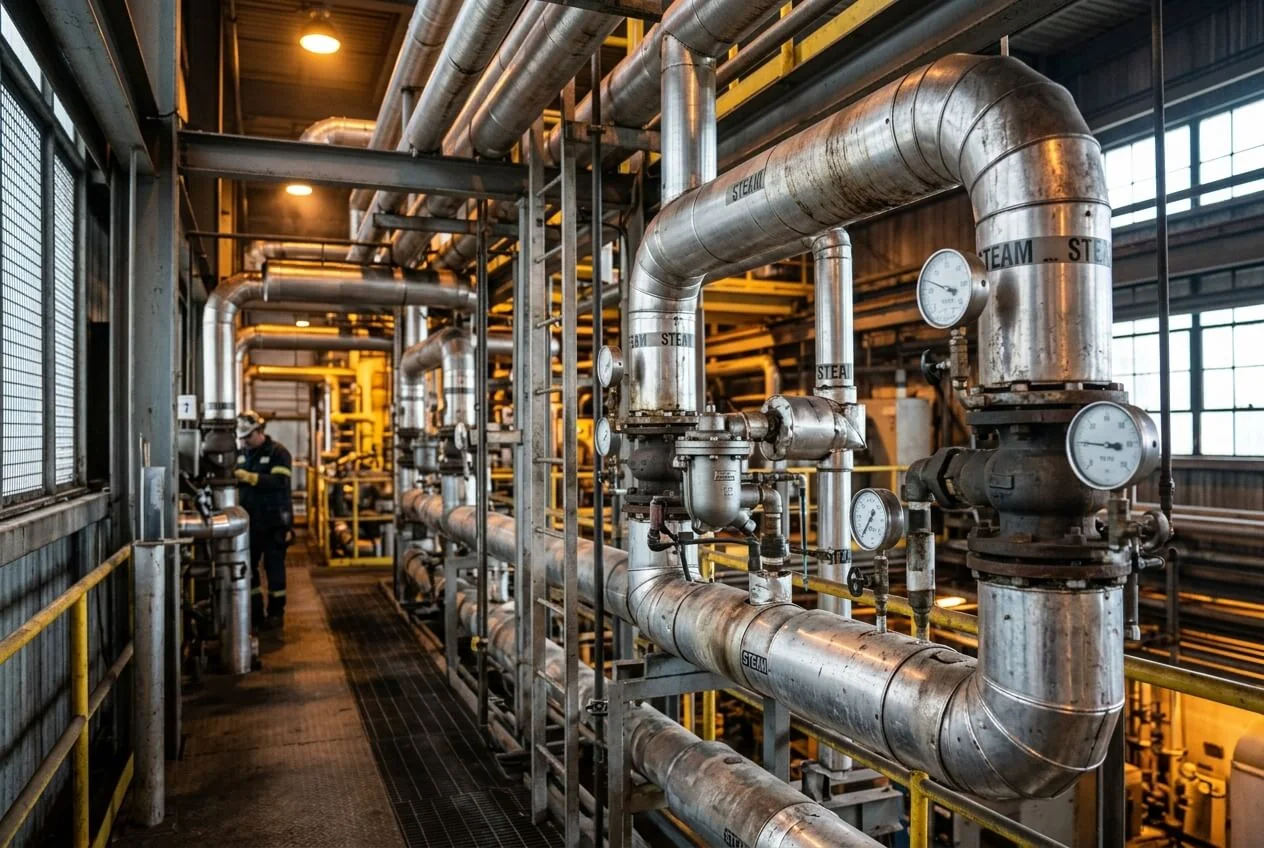
Steam-trap performance depends on the application and the surrounding system. Selection and maintenance should consider condensate load, available differential pressure, air removal and the condition of the return network.
Define the job before choosing the trap
A steam trap removes condensate and gases while limiting the escape of live steam. A drainage point on a steam main and a temperature-controlled process heater do not necessarily need the same solution. The equipment duty and operating range should lead the selection.
Document the upstream operating pressure, expected condensate load, startup behaviour and pressure in the return system. Include any elevation change after the trap. Nominal pipe size alone is not a capacity calculation, and the highest supply pressure is not necessarily the pressure available across the trap throughout a production cycle.
Look beyond the component
Spirax Sarco explains that waterhammer, dirt, pipe layout and variable pressure can affect trap performance. A replacement component may encounter the same problem if the surrounding arrangement is unchanged. Recurring failures are therefore a reason to review the system.
On a modulating heater, the steam-space pressure can fall as the control valve reduces heat input. If that pressure cannot overcome the condensate return conditions, drainage can stall. The engineer should evaluate the operating range and whether an alternative condensate-removal arrangement is needed. This is a system assessment, not simply a choice of a larger trap.
Make the survey repeatable
Create an asset register with a unique tag, location, trap type, served equipment and known operating conditions. Record observations consistently and distinguish equipment that was operating normally from equipment that was idle. An unexplained reading without this context is difficult to act upon.
Spirax Sarco's maintenance guidance discusses several diagnostic approaches and their limitations. A hot body or visible vapour is not sufficient evidence by itself to classify a trap as failed. Qualified survey personnel should interpret appropriate measurements alongside the expected discharge behaviour and surrounding plant conditions.
Turn findings into a maintenance decision
A useful report identifies the evidence, the suspected issue, its effect on production and the next action. Separate urgent drainage concerns from routine inspection and planned replacements. Avoid presenting an estimated energy saving as a guaranteed outcome; calculation assumptions and operating hours need to be visible.
After corrective work, repeat the relevant observations under comparable operating conditions and update the asset record. For a technical enquiry, provide the equipment duty, pressure range, return arrangement and survey history. These details support a reasoned recommendation and a maintenance plan that can be checked over time. Site isolation and permit requirements remain essential for any physical intervention.
Further reading
Discuss your application
Share your process conditions and equipment requirements with Delta Flow Tech.
Ask DFT about thisContinue reading
Why a plate heat exchanger misses its target temperature
Separate a changing process duty from fouling or a flow problem before deciding that the exchanger needs more plates.
Learn morePlanning a hygienic valve automation retrofit
Check the valve, actuator and controls together before selecting a control top or promising additional functionality.
Learn more